NERC Report Shows Only 41% of Power Plants Available Despite 13,625MW Installed Capacity
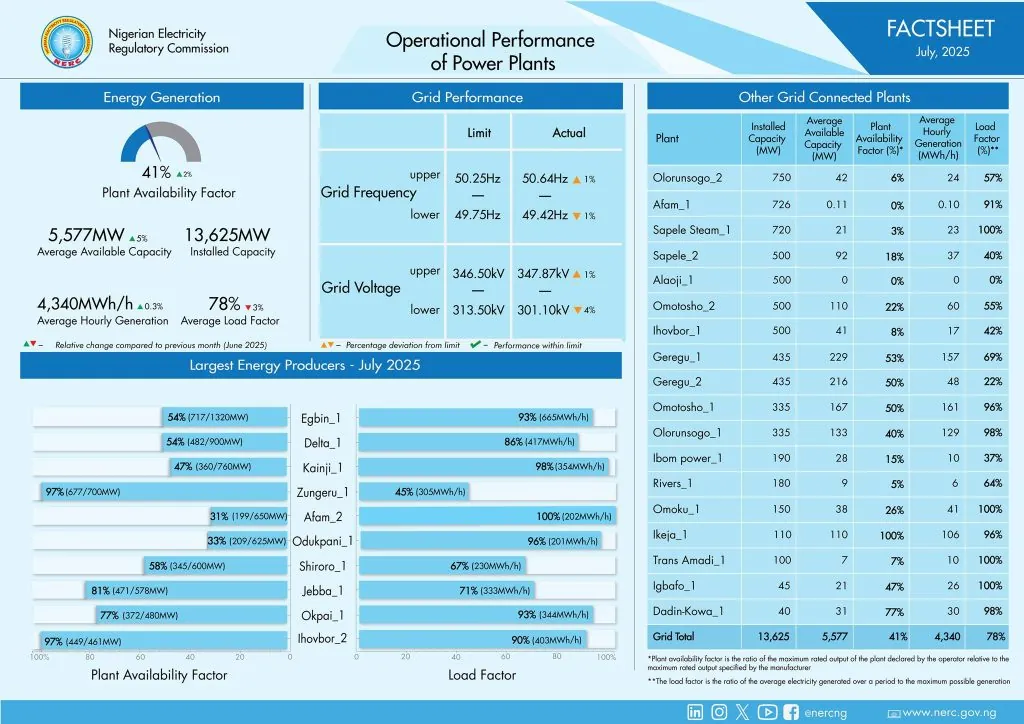
Abuja, Nigeria — August 17, 2025 | Nigeria’s power sector continues to grapple with poor performance, as the Nigerian Electricity Regulatory Commission (NERC) has revealed that only 41 percent of the country’s power plants were available in July, despite an installed generation capacity of 13,625 megawatts (MW).
According to the regulator’s July 2025 factsheet, the average available generation capacity stood at 5,577 MW, marking a marginal 2 percent improvement from June. However, actual average output was limited to 4,340 megawatt-hours per hour (MWh/h), while the grid’s load factor dropped by 3 percent to 78 percent.
The report also flagged recurring technical instability. While the acceptable system frequency is between 49.75 and 50.25 Hz, grid fluctuations pushed readings as high as 50.46 Hz and as low as 49.42 Hz. Voltage levels also fell outside the safe range of 313.50–346.50 kV, with extreme readings of 347.87 kV and 301.10 kV, putting supply reliability under significant strain.
In terms of contributions, five plants dominated July’s power generation. Egbin led the pack with an average of 665 MWh/h at a 93 percent load factor. Delta followed with 417 MWh/h (86 percent), Kainji with 354 MWh/h (98 percent), Okpai with 344 MWh/h (93 percent), and Ihovbor 2 with 403 MWh/h (90 percent).
On the other hand, several facilities recorded little or no output. Afam 1, despite having an installed capacity of 726 MW, was completely unavailable throughout the month. Sapele Steam 1 also underperformed, generating only 3 percent of its 720 MW capacity. In contrast, plants such as Omotosho 1, Olorunsogo 1, Rivers 1, Ikeja 1, Igbafo 1, and Dadin Kowa 1 recorded near-perfect or full load factors, indicating more efficient utilisation of their capacities.
Energy experts argue that the findings highlight Nigeria’s long-standing challenge of bridging the gap between installed capacity and actual supply, a shortfall that continues to affect industrial productivity, economic growth, and household electricity access.